Sunday, June 21, 2009

one great day

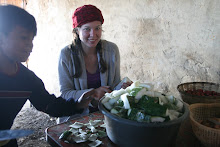
A few months ago, Living Waters for the World came to an aldea of my site and put in a water purification plant.  It's really cool, makes great water and is working well since it got started.  They worked with a local family to put it in, and while they were there they fell in love with the 10-year-old daughter, a beautiful, sweet little girl named Doris.  They also realized that Doris is mostly deaf.  Her hearing loss is so severe that she has never been able to learn Spanish, and only speaks a little Mam.  When LWW left, they asked me to look into finding an ear specialist for Doris and offered to help with the expenses.  

Friday, Doris, her mother and father, and I went to Guatemala City to see a specialist and get a special hearing test done--one that's only offered in the capitol.  This is a 7 to 8 hour trip for someone coming to my village.  Which is not to mention braving the dangers of the city.  Thankfully, we all arrived on time and in one piece at the doctor's office bright and early Friday morning.

Doris' mother stayed in the waiting room.  I went up with her father.  The doctor, a portly Ladino man who said everything with a dramatic flourish, asked her father a few questions about her general health, then took off her ponytail holder and started to massage her scalp and her face.   Then, without warning, he took a pair of scissors off his desk, and began to cut a quarter-sized bald patch on Doris' scalp.  

"Uh...whatcha doin' that for?" I asked.  

"Oh," he said, nonchalantly.  "It's so the electrode will stick on better."  

Like so many moments I have had in this country, I maintained a somewhat placid facade, while my mind scrambled to make sense of the situation and I personally resisted the urge to panic.  Electrodes??? I thought.  What is going on?  What have I gotten this poor family into?  

After a preliminary ear exam, the doctor bade her lie down on a small exam bed.  He then got out four electrodes and proceeded to place one on the tiny bald patch on her skull, one on the middle of her forehead, and one behind each ear.  

"¿La va a doler?"  I asked.  Will it hurt her?

"No," the doctor assured me she wouldn't feel a thing.  I was skeptical, given the fact that what I knew about electrodes involved electroshock therapy or torture devices.  

"¿No la va a dar un choque?"  It won't shock her?

Finally, Mr. Bedside Manners explained that the electrodes only measured brain activity, to see if her ears were sending signals to her brain.  

He then showed us a graph of a normal ear's hearing patterns.  It looked like a mountain range, with five distinguishable points representing different phases of the test.  

The computer began to read Doris' activity.  Where there should have been peaks and valleys, there was nothing but an empty horizon.  No activity.  My  heart froze.  The doctor confirmed my worst fears as he explained to her father and me that the results showed complete deafness in her right ear.  Something the most powerful hearing aid in the world couldn't hope to fix.  

The doctor, explaining the procedure the whole time with his typical unnecessary gravitas, waxed philosophical.  "As you know...we are all capable...of making...errors.  And...I have made an error just now...as it seems the electrodes are not connected to the computer."

Once again, my mind reeled.  What kind of a quack was this?  What if he hadn't noticed?

The computer started a new reading.  Foothills, ridges, and yes, small mountains appeared where before there was nothing but a flat line!  We knew then Doris could hear in one ear and that a hearing aid could potentially help a lot.  

Her left ear showed much less promising results.  But one ear is enough to develop much better speaking, comprehension and social skills.  

Poor Doris!  The test took about 45 minutes, all told.  As the doctor removed the headphones and the electrodes, I could see a little tear starting to slide down her cheek.  As she got down off the table she started bawling.  I offered to go fetch her mother, but the men in the room thought it wasn't necessary.  "It's over, it's over," they said.  I gave her a Strawberry Shortcake pin I had saved from a birthday party goody bag, and she cheered up a bit (thanks Charlotte).  

Afterwards, we went to the Guatemala Zoo.  Now, let me tell you.  If you ever are having a hard time, a depressing season of your life, go to the zoo with a child--or anyone--who's never been before.  The wonder of seeing a live giraffe, tiger or kangaroo for the first time is positively infectious.  Doris' favorites were the meerkats, and we practically had to drag her away from the monkey habitat.  

Friday was one great day.

Tuesday, May 26, 2009

love and mucus sucker balls

Hi Everyone!  

Well, Project 1 has finally been accomplished.  Today I gave out the midwife kits to 11 local midwives.  They were very excited and receptive to get stethescopes, mucus sucker balls, gauze, gloves, a nylon sheet, baby wash, umbilical cutters, umbilical twine, and more.  Many thanks to all of you who helped.

Learning to use the stethoscopes.

Saying "thank you."


The ladies and their kits.  Aren't they a good looking bunch?

Monday, May 25, 2009

facing it

Young people hard at work on the portraits I mentioned in a previous post.  Thanks guys, lookin' good!

Friday, May 22, 2009

the Franco years

This is Franco, my little buddy.  I lived in his house during my first four months in site.  He is what grandparents would probably refer to as "a little stinker."  Around here, he's just travieso.  In fact, he once threw a rotten tomato at me.  However, at the end of the day, I can't help but love the little guy.  We have a lot of fun playing soccer, and I appreciate his imagination.  I went over to their house for dinner last night, and he held up a tortilla, told me it was his motorcycle, and started zooming it around the table.  He also once played soccer with a plastic coke bottle.  Sometimes the armchair psychologist in me thinks that some of his meanness is from separation issues, because his father has been in the United States for pretty much his whole life.  

Wednesday, May 13, 2009

on the line

Tuesday, May 12, 2009

i project

So, I thought I would let you all know about the little projects I am working on right now.  They aren't vast, expansive efforts carefully researched for their sustainability.  One of them isn't even really related to my program at all.  But they are things I think I can do, that I am interested in, which I think have the potential to improve some people's lives just a little bit.  

Project 1:
As I have written before, the local midwives (comadronas) meet for additional training once a month in the Puesto de Salud, where I lead a charla.  We started out talking about things like hygiene during the birth, giving good prenatal care,  danger signs in the pregnancy, birth and newborn.  Then things got technical.  I began doing a lot of research every month and spoke to them about how to cut the cord and care of the placenta.  Finally, we have started to cover broader topics like domestic violence and sexuality.  These ladies are fun.  They are also very intelligent.  Unlike some other groups, they come to every meeting ready to learn.  They participate and add their own comments.  So, when a women's organization called the Zonta Group out of Sarasota, FL with the motto "Advancing the status of women worldwide" donated kits for midwives, I was very excited.  Because almost everything in the kits is disposable, I looked for things to supplement them, like stethoscopes to hear the fetal heartbeat, and those little mucus-sucker-ball thingys.  The kits, while an amazing and generous gift, were a little disappointing when we realized that each one could probably only used for one birth.  I am still looking for more TempoDOT themometers (so they can tell if a woman has a fever--a danger sign) and some rags.  Even though it's not the most sustainable gift, I think it will help the midwives and raise consciousness about hygiene.  Also, I feel good about giving this donation to a group that works hard and always comes in to charlas.

Project 2:
Because of the scarcity of digital cameras, money to make prints, etc, most people have few pictures of their children.  Also, exposure to the arts is limited.  Likewise, I live in a mostly forgotten corner of the world that is not remarkable enough to merit significant coverage in geography or social studies classes.  So, a couple of months ago, I took pictures of all of the students in the sixth grade, and sent them to an art teacher from my home town, Kathy Thompson.  She found a group of artists and interested youth who will paint portraits based on the photos I sent earlier (most of them are from Epworth First Baptist Church, as I understand it, although there are other community partners as well).  Students here will receive portraits of themselves that will hopefully become a cherished keepsake for them and their families for many years.  The artists will receive some cultural education about life here in this rural Guatemalan village as well as the satisfaction of brightening the life of a child.  The portraits are currently under way and should arrive mid to late June.  

So, those are the long term projects I am working on.  If you are interested in getting involved, there are ways you can help!  Just leave a comment or email me.   Many thanks to the Zonta club, Mrs. Thompson, Epworth First Baptist, Demosthenian Literary Society, Len and Carol Crawford and all other community partners involved in these exciting projects!

Saturday, April 25, 2009

no where to run

Today I gave a difficult charla on a very delicate subject—la violencia intrafamiliar, or domestic violence.  I was speaking to the local midwives.  What I was hoping to do more than anything was to just start a conversation about a problem that thrives in secrecy.  As trusted community leaders and health workers in the most remote and underserved areas, these women have a great opportunity to provide counsel to women in distress. 


First I told them a story of a fictional couple named Laura and Luis.  Laura began to suffer from Luis’ beatings, threats and intimidation when she became pregnant.  Things got worse and worse until she realized he was a threat not only to her, but to their children as well.  She finally decided to make a plan.  I asked them what a woman in her situation could do. 


“Nothing,” they all said.  “She just has to suffer through it.”  There’s an old saying in Guatemala “Si te casas, te aguantas” “If you marry, you put up with it.”  They didn’t like the idea of calling the police or going to the justice of the peace, because of what an irate husband could do. 


One midwife shared a terrifying story.  She had a patient who she knew was being abused by her husband, and sadly, the baby was stillborn.  She wanted to go to the justice of the peace about it.  But then the husband began to threaten her, “No matter where you go, no matter what path you take, I’ll find you—and then I’ll kill you,” he told her.  So, the midwife kept her mouth shut about that and decided not to ask so many questions next time. 


I encouraged them to look for skills they have already, like cooking, sewing or making handicrafts to earn money outside of the husband, but they were skeptical.  Even as I suggested different approaches, my solutions sounded a little lame. 


The midwives even refused to be convinced that violence is never the fault of the victim!  This is perhaps the most important point I wanted to impart. 


Basically, it made me realize how entrenched this problem is here.  These women were almost scared to talk about domestic violence in a closed-door room with a group of their friends.  The funny thing is, despite their dismal outlook for women of their generation currently in abusive relationships, they all knew the solution.  Education.  The problems that came up during the charla were always that an illiterate woman with no education and no job training is trapped.  The good news is, the next generation is changing.  More girls are enrolled in schools than the past generation, and thanks to welfare programs like Mi Familia Progresa, enrollment is way up.